
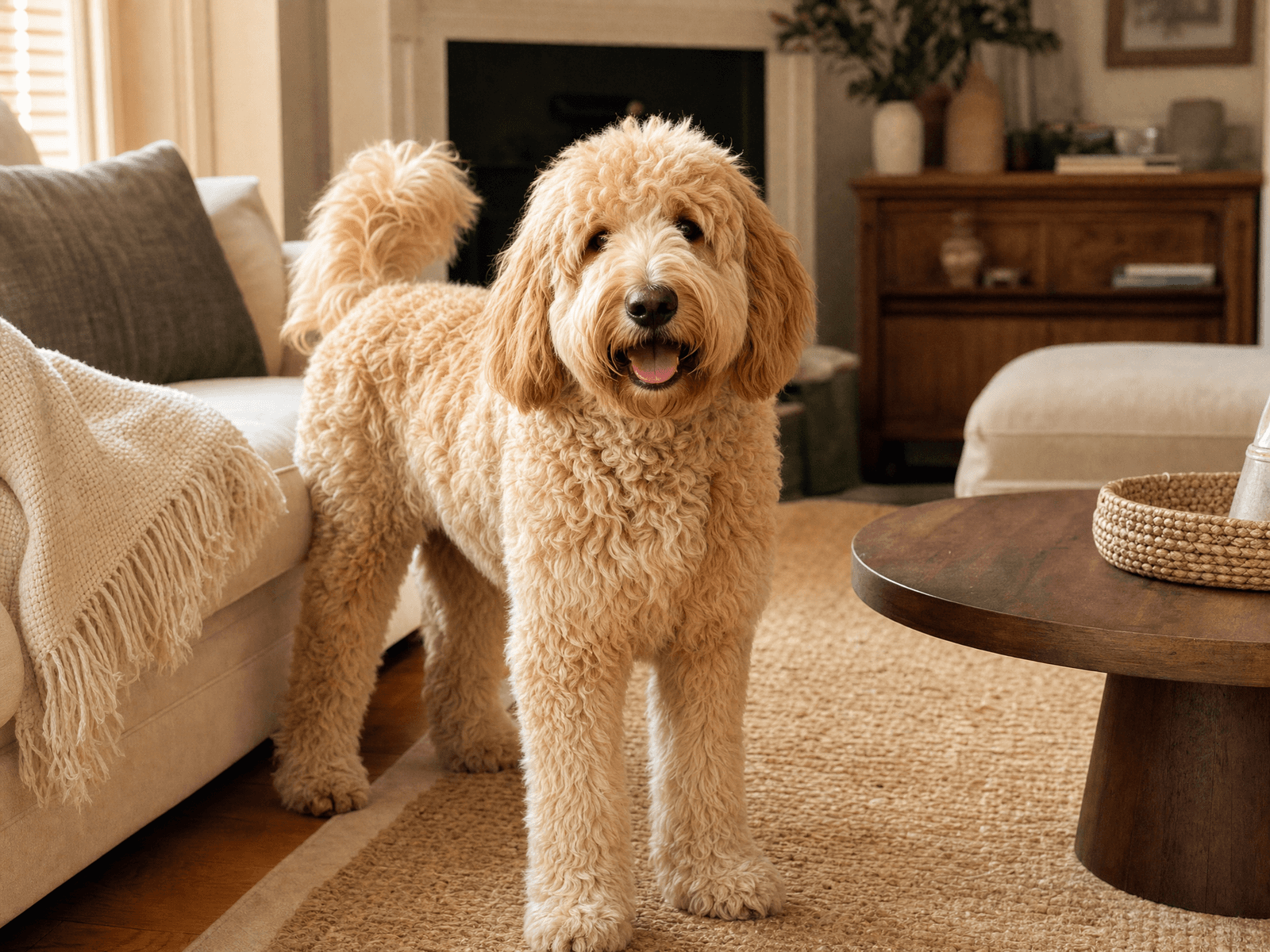
How to Train a Goldendoodle
Blending the eager-to-please retrieving nature of the Golden Retriever with the razor-sharp intellect of the Poodle, the Goldendoodle requires targeted mental stimulation and positive structure to thrive.
The Ultimate Goldendoodle Training Guide: Unlocking Your Poodle-Retriever Mix's Potential
Training a Goldendoodle is an adventure in blending two of the world's most intelligent, high-energy, and people-oriented canine intellects: the Golden Retriever and the Poodle. While this designer mix is celebrated for its hypoallergenic coat and affectionate demeanor, beneath the fluffy exterior lies a sensitive, high-drive, and remarkably clever mind that requires intentional structure, mental stimulation, and positive reinforcement. Because Goldendoodles inherit the retrieval instincts of gun dogs and the problem-solving sharpness of water retrievers, standard one-size-fits-all training approaches often fall short. Whether you are navigating generational sizing variations—from Miniature to Standard—or managing a bouncy adolescent who loves to jump, this comprehensive guide will walk you through everything you need to master your Goldendoodle’s training journey.
Breed Training Profile
---
Understanding the Goldendoodle Mind
To train a Goldendoodle successfully, you must first understand the genetic engine driving their behavior. As a cross between the Golden Retriever—bred to retrieve game birds softly and tirelessly all day—and the Standard, Miniature, or Toy Poodle—bred as agile water-retrieving hunting companions with genius-level problem-solving capabilities—the Goldendoodle is genetically programmed to work closely with humans. They possess an extraordinary emotional intelligence, reading human body language, tone of voice, and facial expressions with startling accuracy. This sensitivity is a double-edged sword: while making them easy to motivate through praise, it renders them vulnerable to harsh corrections and chaotic environments. Intimidation causes them to shut down or develop avoidance behaviors.
What truly motivates a Goldendoodle is not merely food; their ultimate reward is engagement and cooperation with their human. They live to participate in family life, making interactive play and toy rewards potent motivators. However, their high intelligence presents a unique challenge: they learn bad habits just as quickly as good ones. If counter-surfing results in attention or food, they will repeat it. Furthermore, because of their Poodle heritage, they bore easily with repetitive drilling. Effective training must therefore be dynamic, mentally stimulating, and rooted in clear boundaries.
---
What Works & What Doesn't
---
Training Timeline: The First 6 Months
Navigating the first half-year of your Goldendoodle's life requires a structured roadmap that balances socialization, impulse control, and foundational obedience.
Month 1 (Weeks 8–12): Integration, Bonding, and Crate Foundation
Month 2 (Weeks 13–16): Lure-Reward Obedience and Socialization Peak
Month 3 (Weeks 17–20): Environmental Proofing and Impulse Control
Month 4 (Weeks 21–24): Adolescent Testing and Adolescence Precursor
Month 5 (Weeks 25–28): Advanced Impulses and Adolescent Boundaries
Month 6 (Weeks 29–32): Adolescence Consolidation
---
Essential Commands for the Goldendoodle
While every dog needs basic manners, these five commands are uniquely tailored to the physiological and psychological profile of the Goldendoodle.
1. The High-Value "Leave It" (Managing Retriever Predilection)
2. Automatic Check-In / "Watch Me" (Beating Distractibility)
3. The Stationary "Place" Command (Channeling High Energy)
4. Zero-Tolerance "Off" (Managing Jumping and Greeting Etiquette)
5. Emergency "Recall" (Come When Called)
---
The Biggest Challenge: Managing Coat Maintenance Sensitivity and Over-Arousal
The single greatest training hurdle unique to the Goldendoodle is not obedience or basic house manners—it is conquering grooming sensitivity combined with adolescent over-arousal. Because Goldendoodles are a hybrid mix, their coats range from straight shedding fleece to tightly curled non-shedding hair that mats with terrifying speed if neglected. Consequently, professional grooming every 6 to 8 weeks is non-negotiable. However, because doodles are exceptionally high-energy and sensitive, the combination of standing still on a stainless-steel grooming table, the whine of clippers, the heat of blow-dryers, and the tugging of slicker brushes often triggers intense anxiety, defensive mouthing, or frantic writhing.
Owners frequently make the mistake of waiting until the dog is 6 months old and fully matted before bringing them to a groomer, resulting in a traumatic first experience where the dog has to be shaved down and is held down by stressed staff. Overcoming this challenge requires systematic desensitization starting on day one at home. You must train cooperative care by pairing the touch of an electric toothbrush (simulating clippers) near the ear with high-value peanut butter licked from a mat, handling paws while feeding freeze-dried liver, and introducing brushing as a massage ritual rather than a chore of torture. Furthermore, because over-arousal causes doodles to bite grooming tools in play or frustration, handlers must teach a strict "Stationary Stand" and "Chin Rest" behavior, allowing the dog to actively participate in their own grooming restraint through cooperative consent training.
---
Common Owner Mistakes
1. Assuming Hybrid Vigor Equals Automatic Good Behavior: Many owners fall for the marketing myth that designer mixes are "maintenance-free" dogs that train themselves. In reality, combining two working breeds (Retrievers and Pointers/Poodles) often yields a dog with double the intelligence and energy, requiring rigorous mental structure.
2. Inconsistent Boundary Enforcement: Doodles are master manipulators of human emotion. When a cute 15-pound puppy puts their paws on the counter, owners laugh and feed them. When that same puppy reaches 50 pounds, the behavior is suddenly punished—confusing the dog and breaking trust. Rules must be ironclad from day one.
3. Under-Exercising the Brain While Over-Exercising the Body: Jogging miles with a young Goldendoodle builds extreme physical stamina without tiring out their brain, resulting in an athletic adolescent who demands more and more exercise every single day. True fatigue comes from scent work, puzzle-solving, and obedience shaping.
4. Permitting "Velcro" Dependency Without Alone Time: Because Goldendoodles are bred to work closely by our sides, they readily develop severe separation anxiety if they never experience independent time. Confining them to a crate only when you leave—rather than making the crate a safe, positive haven throughout the day—creates lifelong panic responses.
---
Frequently Asked Questions
1. How do I stop my Goldendoodle puppy from biting and mouthing my hands?
Goldendoodle puppies possess strong retrieving instincts and use their mouths to explore the world, combined with high social excitement. When your puppy mouths your hands during play, do not pull your hand away rapidly (which triggers their prey-drive chase instinct) or shout angrily. Instead, give a sharp, neutral vocal interruption ("Ah-ah!" or "Time Out"), immediately withdraw all attention by turning your back or stepping behind a baby gate for 30 seconds, and return only when calm. Consistently redirect their biting urge to an appropriate interactive toy like a tug rope or rubber chew ring.
2. Why is my Goldendoodle so hyperactive in the evening, and how do I calm them down?
The infamous "witching hour" or evening zoomies in Goldendoodles are usually caused by pent-up physical fatigue mixed with delayed parasympathetic nervous system downregulation. After a full day of sights, sounds, and stimulation, adolescent doodles experience an adrenaline spike. To combat this, do not engage in high-arousal fetch games late at night. Instead, implement a mandatory decompression protocol: feed dinner out of a frozen stuffed Kong or snuffle mat, practice calm down-stays on their place mat, and use classical music or white noise to signal that the active day has concluded.
3. How do I handle the coat variation and grooming training if my doodle has a high-maintenance fleece coat?
Coat type in Goldendoodles is unpredictable due to generational variation (F1, F1B, Multigen), meaning your puppy could inherit a flat retriever coat, a wavy fleece coat, or a tight Poodle wool coat. Regardless of the texture, start daily brush training at 8 weeks old using a slicker brush and metal greyhound comb, working down to the skin (not just skimming the topcoat). Keep sessions extremely short—two minutes maximum—paired with high-value treats. If your dog exhibits head-shyness or snaps at the brush, do not force the issue; consult a professional positive-reinforcement trainer or fear-free groomer to establish cooperative cooperative husbandry foundations before mats form.
---
References
1. Stanley Coren. *The Intelligence of Dogs: A Guide to the Thoughts, Emotions, and Inner Lives of Our Canine Companions*. Bantam Books, 2006.
2. Patricia McConnell. *The Other End of the Leash: Why We Do What We Do Around Dogs*. Ballantine Books, 2003.
3. Ian Dunbar. *Before and After Getting Your Puppy: The Positive Approach to Raising a Happy, Healthy, & Well-Behaved Dog*. New World Library, 2004.
4. Sophia Yin. *Low Stress Handling, Restraint and Behavior of Dogs of Cats*. CattDog Publishing, 2009.
Quick Reference
Download This Guide
Get the full Goldendoodle training guide as a PDF.
Training advice reflects general breed tendencies. Individual dogs vary. Consult a certified trainer for persistent behavioral issues.