
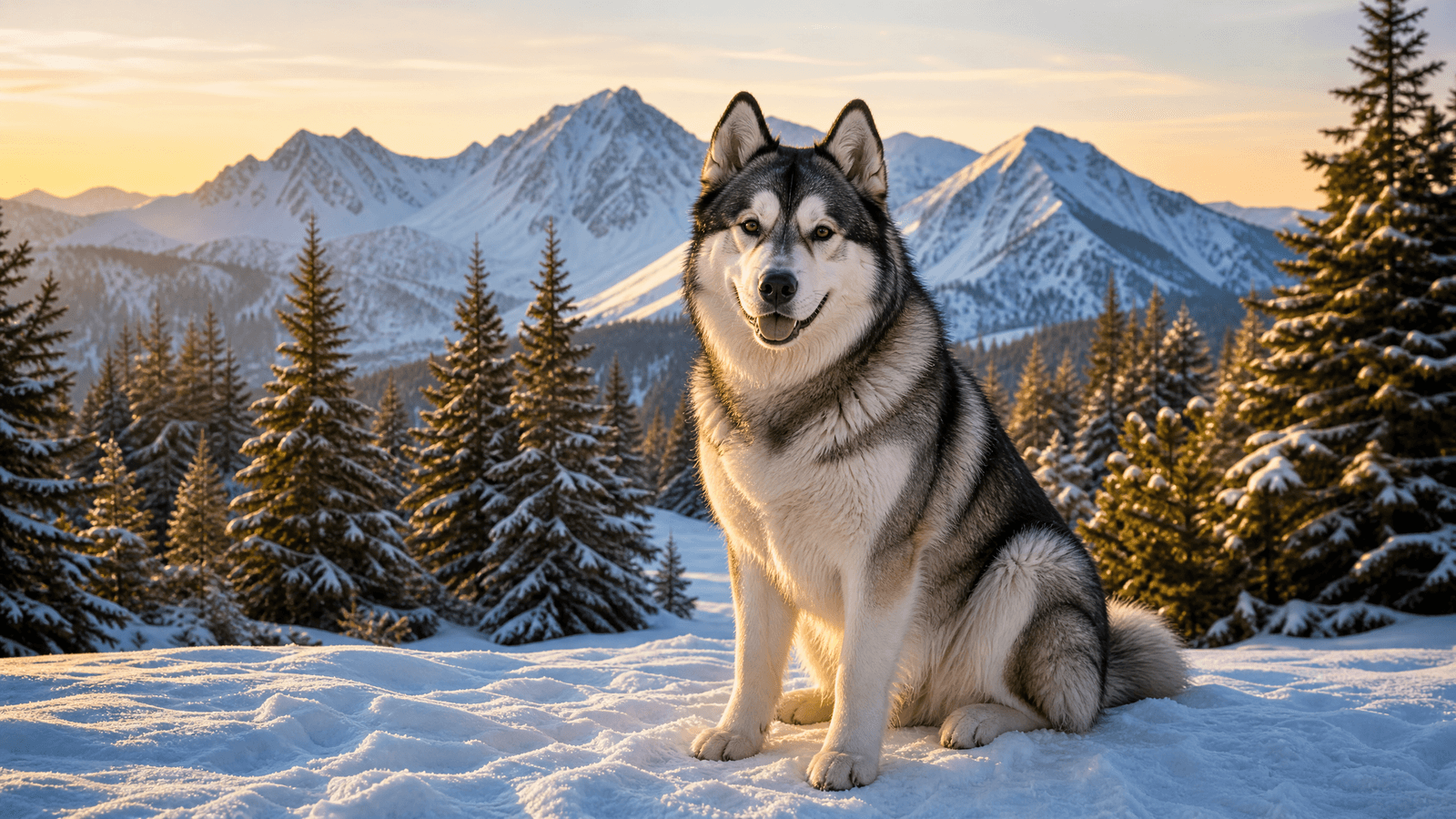
How to Train an Alaskan Malamute
Training an Alaskan Malamute is not about demanding blind obedience; it is about establishing a respectful partnership with an independent, powerful ancient sled dog who evaluates every command on its own merits.
The Ultimate Alaskan Malamute Training Guide
Training an Alaskan Malamute is not about demanding blind obedience; it is about establishing a respectful partnership with an independent, powerful ancient sled dog who evaluates every command on its own merits.
Breed Training Profile
---
Understanding the Alaskan Malamute Mind
To successfully train an Alaskan Malamute, an owner must first understand the evolutionary pressures that shaped this magnificent Arctic breed. Bred by the Mahlemut Inuit people of northwestern Alaska, Malamutes were engineered to haul heavy freight across frozen tundras in extreme sub-zero temperatures. Unlike herding dogs like Border Collies—which were bred to collaborate closely with humans on every micro-movement—or retrieving gun dogs bred to eagerly await a handler's signal, sled dogs operated as part of a team over vast distances where independent survival and problem-solving were paramount.
This ancestral heritage creates a distinct psychological profile. A Malamute does not possess the natural "biddability" or eager-to-please mentality found in Labrador Retrievers or Golden Retrievers. When you give a Malamute a cue, they do not automatically think, *“How can I make my human happy?”* Instead, their internal cognitive process is more akin to, *“What is in this for me, and does your request make logical sense right now?”* This independence is frequently mislabeled as stupidity or stubbornness, but in reality, Malamutes are remarkably intelligent. Their intelligence, however, is practical and self-directed rather than compliance-oriented.
Motivating a Malamute requires creativity and high-stakes incentives. Standard low-value kibble will routinely fail during training sessions, especially outdoors where scents, wildlife, and interesting terrain compete for their attention. High-value rewards such as small pieces of roasted liver, dried fish, or cheese are essential. Furthermore, Malamutes are strongly motivated by physical movement and environmental exploration. Incorporating structured walks or brief games of tug-of-war as life rewards can often motivate a Malamute far more effectively than food alone.
Conversely, traditional punitive or correction-based training methods backfire catastrophically with this breed. If you attempt to force compliance through physical dominance, alpha rolls, or harsh leash jerks, a Malamute will not submit; they will either shut down entirely or push back with stubborn resistance. They have a strong sense of dignity and fairness. Training must be built on mutual trust, clear and consistent boundaries, and positive reinforcement. If sessions are repetitive, boring, or overly drill-oriented, a Malamute will simply turn around and walk away, signaling that they have better things to do.
---
What Works & What Doesn't
---
Training Timeline: The First 6 Months
Navigating the first half-year of a Malamute puppy's life requires patience, structure, and proactive socialization. Because Malamutes grow rapidly from fluffy puppies into powerful adult dogs capable of pulling heavy loads, establishing good habits early is non-negotiable.
Month 1 (Weeks 8–12): Foundation and Bonding
Month 2 (Weeks 13–16): Basic Cues and Leash Introduction
Month 3 (Weeks 17–20): Adolescence Precursor & Environmental Exposure
Months 4–6 (Weeks 21–26): Teenage Testing & Advanced Distractions
---
Essential Commands
Training a powerful Arctic breed requires focusing on commands that ensure safety, manage high physical drive, and maintain control in dynamic environments.
1. "Leave It" (The Ultimate Safety Cue)
Malamutes have a powerful prey drive and an investigative scavenging instinct. They will readily investigate wildlife, dropped food items, or debris on trails.
2. "Wait" (Impulse Control at Thresholds)
Given their immense pulling power and enthusiasm for outdoor exploration, bursting through doors or bolting out of crates creates severe safety risks.
3. "Come" (Reliable Recall Under Distraction)
Malamutes possess an independent streak that can make off-leash recall challenging. Building a bulletproof recall is essential for preventing dangerous roaming.
4. "Let's Go" / Loose Leash Walking
An adult Alaskan Malamute can weigh anywhere from 75 to 85+ pounds and is built specifically to haul freight. If they pull on a standard leash, walking them becomes an exhausting wrestling match.
5. "Enough" (Interrupting Arousal and Vocalization)
Malamutes are famous for "talking"—emitting dramatic "woo-woo" vocalizations, howling, and expressing intense opinions. While endearing, this can become disruptive without a reliable cue to quiet down.
---
The Biggest Challenge: High Prey Drive & Managing Independence
The single greatest training challenge with an Alaskan Malamute is navigating the collision between their powerful predatory drift and their autonomous, independent mindset. Unlike herding dogs that nip at heels or guard dogs that patrol boundaries, Arctic sled dogs were historically expected to hunt for small game when food was scarce and to operate with minimal human oversight across treacherous terrain.
Today, this manifests as an intense drive to chase fast-moving small animals—including squirrels, rabbits, neighborhood cats, and small dogs. When a Malamute locks onto prey, their tunnel vision is absolute; auditory cues from their owner are effectively filtered out by a rush of adrenaline. Compounding this challenge is their independent temperament: even if they hear you, their cost-benefit analysis may lead them to conclude that catching the squirrel is far more rewarding than receiving a piece of kibble.
Overcoming this challenge requires a proactive, multi-layered management and training strategy. First, owners must accept that an adult Malamute can rarely be trusted off-leash in unsecured environments. Reliable containment—such as secure 6-foot fencing with buried wire mesh to prevent digging—is non-negotiable, as Malamutes are legendary escape artists who will tunnel under fences when bored.
Second, training must focus heavily on impulse control and desensitization around triggers. Utilizing the "Premack Principle," owners can teach their Malamute that looking at wildlife and then turning back to look at the handler earns high-value rewards. Long-line training in controlled open spaces allows handlers to practice emergency stops and recalls safely. Furthermore, owners must redirect their dog's predatory and physical energy into appropriate outlets, such as weight pulling, backpacking, and agility sports. By channeling their ancestral working drive into structured tasks, the urge to bolt after wildlife is significantly diminished.
---
Common Owner Mistakes
1. Treating Them Like a Golden Retriever: Owners often expect instant, unquestioning obedience and eager eye contact. When a Malamute pauses to evaluate a command, inexperienced owners repeat the cue multiple times, rendering the command meaningless and frustrating the dog.
2. Underestimating Exercise and Mental Stimulation: Providing a quick walk around the block is insufficient for a dog engineered to pull heavy loads across frozen wastelands. Bored Malamutes express their frustration through destructive chewing, incessant howling, and dramatic yard excavation.
3. Using Aversive Correction and Physical Force: Attempting to dominate or physically punish a Malamute destroys mutual trust. Because the breed possesses a strong sense of dignity and self-preservation, physical corrections lead directly to defensive aggression or stubborn shutdown.
4. Failing to Secure the Perimeter: Assuming a standard fence or an invisible fence will contain a Malamute is a critical error. Malamutes possess immense strength, can jump surprisingly high when motivated, and are prolific diggers capable of tunneling out of a yard in minutes.
---
Frequently Asked Questions
Can I ever let my Alaskan Malamute off-leash in an open park?
For the vast majority of Malamutes, reliable off-leash reliability in unsecured public spaces is unrealistic and unsafe. Because of their high prey drive and independent nature, their instinct to roam or chase wildlife will frequently override training. Safe off-leash exercise should be restricted to securely fenced areas or private enclosed fields.
Why does my Malamute "talk" back, and should I punish this behavior?
Malamutes are exceptionally vocal dogs, known for emitting melodramatic "woo-woos," whines, and howls. This is a normal breed characteristic used for communication within the pack, not disobedience or defiance. Punishing or yelling at them for talking is counterproductive; instead, acknowledge their communication calmly or teach an "Enough" cue to manage excessive vocalization.
How do I stop my Malamute from pulling my arms off during walks?
Because Malamutes are built to pull heavy freight, standard leash walking goes against their natural biomechanics. To manage pulling, utilize a front-clip harness or a head halter that redistributes leverage, combine this with the "Be a Tree" technique (stopping dead whenever tension occurs), and reward loose-leash positioning consistently with high-value treats.
---
References
1. American Kennel Club. (2024). *Alaskan Malamute Dog Breed Information*. https://www.akc.org/dog-breeds/alaskan-malamute/
2. Coppinger, R., & Coppinger, L. (2001). *Dogs: A Startling New Understanding of Canine Origin, Behavior, and Evolution*. University of Chicago Press.
3. Coren, S. (2006). *The Intelligence of Dogs: A Guide to the Thoughts, Emotions, and Inner Lives of Our Canine Companions*. Free Press.
4. Grandjean, D. (Ed.). (2006). *The Dog: Biology, Medicine, and Management*. Royal Canin.
Quick Reference
Download This Guide
Get the full Alaskan Malamute training guide as a PDF.
Training advice reflects general breed tendencies. Individual dogs vary. Consult a certified trainer for persistent behavioral issues.